The best teams don’t just work — they are awake. They bring awareness to every hour and intention to every action. They understand that time is not merely a resource to be spent but a lens that reveals where energy is flowing, where value is created, and where potential is lost.
When people become fully awake to how they invest their time, they stop scattering effort and start compounding it. They make deliberate choices. They focus on the essential. They align their daily actions with the company’s highest priorities. And together, they generate results that are greater than the sum of their hours.
This is the environment where A-players thrive — one defined by clarity, purpose, and momentum. It’s where awareness replaces distraction, where intention replaces inertia, and where every hour moves the enterprise closer to its vision.
Build that kind of team, and you don’t just get more done — you build something enduring.
BETTER than the Big Three (GCal, Outlook, Apple)
This is Democratized ERP.
Syncs with QuickBooks Online and most Email.
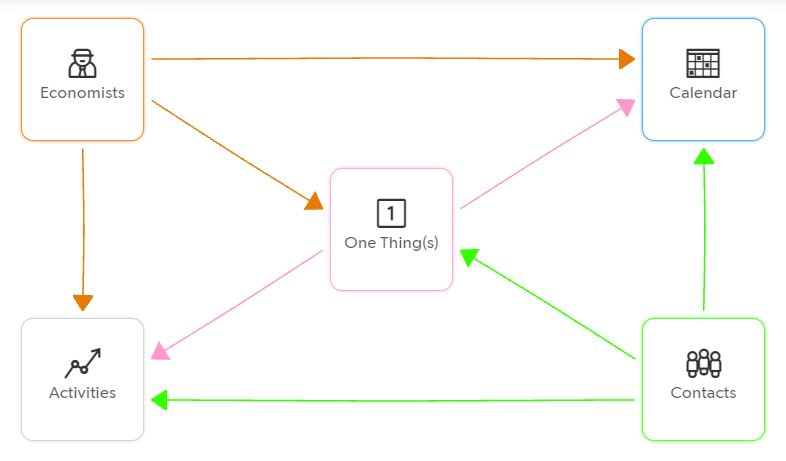
Relate: Plans to Actuals, Efforts to Results.
|
WHO WILL WANT THIS:
Small-to-Midsize Business Owners
Operations Managers & Admins
High-Performers & Executive Assistants
Teams Moving From Paper or Whiteboards
|
Problems This Solves
| Problem | How this solution fixes it |
|---|---|
| Calendars are a blur of identical gray events | Color-coding by Activity Type creates instant pattern recognition — at a glance you see priorities and balance. |
| People forget to confirm appointments | Automated confirmations & reminder “nags” fire at the right time and stop once the person responds. |
| Manual calendar upkeep is tedious | Pipelines seed events, populate tokens, and update fields automatically — less clicking, fewer errors. |
| No-shows and last-minute surprises | One-click Confirm / Reschedule / Decline links make the schedule self-cleaning and predictable. |
| Hard to analyze where time actually went | Reporting by Activity Type (and therefore by color) turns your calendar into a scorecard of time investment. |
| Double-booking risk and missed handoffs | Confirmation status + tokens surface conflicts early; dashboards highlight unconfirmed or at-risk events. |
| Scaling from a few events to thousands | Simple Case() mapping and reusable pipelines mean new types/users/volume require minimal configuration. |
| Lack of focus on high-value work | Strong hues for revenue activities (e.g., Prospecting, Planning) make them pop and reinforce good habits. |
How Many People Struggle With This
Calendaring chaos is nearly universal:
- Surveys show 50–60% of small business owners feel they “live in their inbox” and lack proactive time planning.
- In service industries, 10–30% of appointments are no-shows — confirmations directly hit the bottom line.
- Knowledge workers burn 3+ hours/week on calendar coordination (“When can we meet?” back-and-forths).
- Most calendaring tools (Google, Outlook) are too flat: they don’t differentiate types of work visually or generate KPIs.
This means millions of SMBs and internal teams are a potential market — basically anyone who lives by a schedule but hates managing it manually.
Why It’s Powerful
- Scalable: You can add 50 activity types, 100 users, or 1,000 events/day — the logic holds.
- Extensible: Layer in time keeping, ROI tracking, or billing rules without re-architecting.
- Emotional: It’s not just data — it feels satisfying to see your day visually balanced.
- Habit-Shaping: Color makes it obvious when you’re doing too much low-value work — creates behavior change.
|
Time:
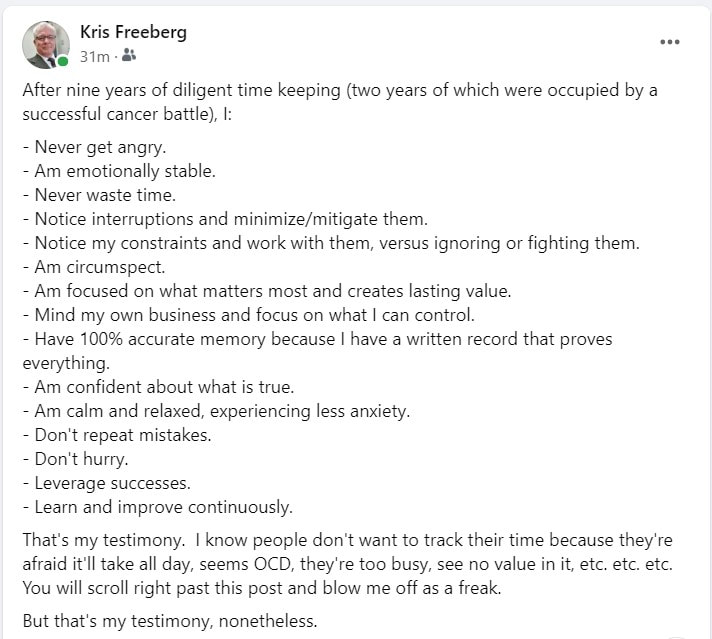
It's everyone's raw material. How do you feel about how you've been spending yours? Do you have regrets? Do you ever space out? Has your time been ravaged by the distraction-rich social media environment in which we find ourselves? Have you figured out what your "One Thing" is, and do you want a way to make sure you spend your time doing it? Do you get distracted by cute pet pictures on Facebook, and the next thing you know 45 minutes have gone by and you don't know where they went? Or are you like The Oatmeal guy who spends more than 45 minutes, finding himself still sitting in his underpants at 3:00 in the afternoon, wondering where the day went? Are you making enough money? Do you need to spend less time doing unrewarding things so you can spend more of it doing rewarding things? Do you ever wake up and ask yourself what happened yesterday, last week, last month, last year . . . to your whole life? As an Economist, because I recognize that time is everyone's raw material, I've always been interested in best time management tools and practices, from calendaring to project management to timekeeping to Getting Things Done (GTD) organization methods. Years ago I devised a hybrid time keeping system for myself, consisting of daily paper time sheets that I summarized by hand and logged the summaries into a computer database. I did that for eight years, from 1996-2003 inclusive, and it helped me launch my business successfully during an otherwise trying time, and maintain my work-life balance. It focused my attention on what I had to do, and kept me positive and goal-oriented. Now I'm pleased to announce that I've been able to take the best from that experience, combine it with my findings from researching best tools and practices in the field, and produce a simple, easy to use mobile and cloud-friendly time keeping system unlike any other in that it doesn't just track, categorize, and summarize time; it relates it to RESULTS, which we can work together to describe in YOUR TERMS. Because it's cloud-hosted, it can be designed just for you, or for your team. How cool is that? So please, contact me for a demo. Let's begin today to make the most of your time. For your success, Kris Freeberg, Economist |
Having Lived More Than Half of a Century
12/24/2016 Having lived more than half of a century, I now know what can fit in a year. Tracked my time just as though it were money. The findings are now crystal-clear. Precious little, it seems. Life is full of Surprises, diversions, distractions; Consequences perhaps unintended That arise from impetuous actions. Now I look at a year as a very small thing In which only one or two goals Can fit without stirring up conflict 'Tween ambitious and well-meaning souls. So I narrow my goals down to just one or two. Keep it simple, and sweet, and sublime. Accept my God-given mortality, Making the most of the time. Of maturity, I find here's the essence. Puerile kids think they can have it all. But adults understand their mortality After many a stumble and fall. How to narrow them down, then? What filter? Axiology figures it out. Clarify values and doctrine, That you might live sans worry and doubt. Figure what's first, and then do it. Don't worry so much 'bout the rest. And think longer term. Look past the next year, As you work here and now on what's best. Those future years are where the other goals go. But for this year, achieve one or two. I'm sharing this 'cause I want the very best Of success for all loved ones, like you. Yes, a life that's Entirely Pleasant, That's replete with Occasions Sublime, Will be yours for the taking if only You work well with this gift we call Time. I care about you very deeply T'ward bliss I want your life to go. Axiology will help you get there. It will help you know when to say “No.” And if one or two goals are all you pursue, You'll be saying “No” most of the time. So get used to it. Live apophatically. Be blessed by this wisdom, in rhyme. |
"But Clockify is Free"
|
| Aspect | Project-Centric Systems (Clockify, Harvest, Toggl, QuickBooks Time, most Order Management Systems, or OMS) |
Day-Centric Systems (Existential Time Keeping, or ETK; Reclaim.ai, Chronometer) |
|---|---|---|
| Organizing Principle | Work is logged by project or client. The day is just a timestamp on the entry. | Work is organized by day or time block. Projects occupy slices of the daily canvas. |
| Calendaring | Commonly outsourced. | Completely integrated. |
| Core Question | “Where did my time go?” | “What will my time become?” |
| Primary Use | Billing, cost analysis, and after-action reporting. | Planning, intention setting, and rhythm management. |
| Temporal Focus | Retrospective — recording what happened. | Prospective — shaping what will happen. |
| Invoicing | Ornamental | Operational |
| Strengths | Excellent for job costing, accountability, and performance metrics. | Excellent for focus, balance, and sustainable productivity. |
| Blind Spots | Ignores rhythm, recovery, and context. Encourages reactive work. | Can drift toward idealism or rigidity if disconnected from real projects. |
| Underlying Schema | Project → Task → Time Entry (User, Date, Duration) | Day → Time Slot → Activity (Event, Category, Energy, Customer, Project, Outcome, vital KPIs) |
| Best Used For | Tracking and analyzing where team effort is going. | Designing and defending the shape of one’s week. |
| Ideal Integration | Feed actual hours into scorecards, contribution-margin dashboards, and planned events/tasks for spot comparisons. | Feed planned hours into calendars, One-Thing tables, and reflection loops. Sync customers & revenues from QuickBooks Online to relate hours to actual revenues and eliminate duplicate contact records. Track project profitability in QBO as a single source of financial truth and no cross-platform reconciliation hassles. Integrate email for a complete 360 degree view of customer relationships. |
| QuickBooks Online Integration | Minimal, frustrating, short-sighted. A design after-thought. | Thorough. |
| Trade Offs | Cheap / free in exchange for light design built around "Freemium" revenue model. | Versatility, thoroughness, and rigor at a higher cost. You get what you pay for. |
| Summary | Looks backward — managerial control of time as a cost center. | Looks forward — existential stewardship of time as a finite asset. |
In higher stages of Operational Maturity, there is no trade-off between project accountability and daily rhythm. The two are complementary.
Projects still supply structure, costing, and clarity of purpose — but the day is the stage on which they perform.
When a company operates at this level, the calendar ceases to be a chaotic list of obligations, and becomes an intentional theater for value creation. Each block of time represents a conscious allocation of energy toward specific outcomes.
The organization stops “tracking time” and starts designing time. In that shift, efficiency and profitability rise together: every actor knows its cue, every project has a place in the day, and the play runs on schedule.
Take This Job and Graph It
On American defiance and the psychology of time data
By Kris Freeberg, Economist | October 23, 2025
Johnny Paycheck’s 1977 anthem, “Take This Job and Shove It,” was more than a country hit. It was a declaration of American metaphysics. Our nation has always had a complicated relationship with authority—we were born by defying it—and the echo of that rebellion still reverberates in our workplaces, our politics, and our software.
That’s why time-tracking apps trigger such visceral reactions in Americans. To a Serbian (Clockify) or Malaysian (Jibble) engineer, clocking in is simply a signal of reliability—a way to coordinate, to belong. To an American, it’s a test of loyalty, a small humiliation. We instinctively hear a foreman’s whistle when the timer starts ticking.
“If my boss wants to track every minute, he can do it himself.”
“We’re adults here—not factory workers.”
“Another corporate nanny app? Hard pass.”
These aren’t just complaints about software. They’re micro-manifestos of a culture that equates measurement with mistrust. The American worker’s creed could be summed up as: Judge me by my results, not by my timestamps.
And yet—paradoxically—we are obsessed with data. We wear smart watches that count our steps, apps that log our calories, dashboards that tally our productivity. We crave the mirror, but we resent the supervisor. What we want isn’t surveillance; it’s sovereignty.
That’s where a new philosophy of time data comes in. The point isn’t to police hours; it’s to reveal value. The purpose of a timesheet isn’t to prove you were working—it’s to understand what your work is worth. When data flows upward into clarity rather than downward into control, the defiance relaxes. Measurement becomes mastery.
So yes, Johnny Paycheck had it half-right. You can take this job and shove it--or you can take this job and graph it. Because the only thing better than freedom is knowing exactly what your freedom costs—and earns. □